Some nights are completely uneventful. You turn out the light, roll over, and wake up at cock's crow, refreshed. Other nights, you regain a blank, black consciousness to find yourself holding someone else's television, or standing by an open window on the first floor.
But some nights are deceptive. You dog-ear the page you're reading, close your eyes and drift off to sleep happily enough, but when you wake up, the world has shifted slightly. A small, almost imperceptible change has taken place: you are no longer who you were.
Last night, the sky was clear and pin-prick-holey with points of cold light. The Milky Way surged eastward and all around, leaves rattled dully in a crescendoing breeze. The trees waited in the dark as if nothing made any difference to them. So did I.
But something did make a difference, and when I woke, I knew the night had changed me. A flame had been extinguished; something had been stilled. I was not displeased with these results. Trying to be my old self has proven pointless. The old tracks had buckled and rusted in the space of hours; there's no way back now.
Sunday, July 11, 2010

Wednesday, July 7, 2010
It's The News, Fucker
I know. I keep bitching about the media, mostly about The News.
Well, here's the solution to that dream I had about making my own newspaper. I am pleased to present to you, It's the News, Fucker, which is the news roughly as I would have it.
Actually, I'm not sure whether that's actually true (I'm already alarmed by the content under the heading "World Politics"), but I intend to find out over the coming weeks.
Well, here's the solution to that dream I had about making my own newspaper. I am pleased to present to you, It's the News, Fucker, which is the news roughly as I would have it.
Actually, I'm not sure whether that's actually true (I'm already alarmed by the content under the heading "World Politics"), but I intend to find out over the coming weeks.
[so bad after all]
[I let go of the scaffolding and stepped forward. Behind me, Dan was silent. Gareth let out a mirthless "Ha." My eyes were on the far end of the plank, where it crossed the roofline again: safety. I took another step, expecting the plank to bow, but it didn't. It didn't even move.
This isn't going to be so bad after all, I thought.
I took another step, glancing down to make sure my feet were in the middle of the plank. I blinked and kept going, my hands lifted from my sides for balance. I took another step, then another.
The breeze chilled my face again. My eyes began to water. I looked down, trying to clear my vision, but everything was a blur. My sneakers, the plank, and the grass far below all merged; they slopped and surged sickeningly.
Then: dizziness, and the sense that my feet were no longer on the plank. I straightened out right before I hit the ground.
"Shit! Shit!" I could hear Dan squeaking from far away. When I opened my eyes, he was racing back along the roof edge toward the ladder we'd climbed from the balcony. He was petrified: I could see it in the way he moved, his knees bent, head down, those clammy hands wrapped tight around the scaffolding.
Gareth stood where I'd left him. He was leaning on the scaffolding, looking down on me from that great height. I couldn't see his face, though: the clouds reflected the light behind him, and he was black. A wraith, a lanky silhouette, my friend now nothing more than a dark figure against the sky.]
This isn't going to be so bad after all, I thought.
I took another step, glancing down to make sure my feet were in the middle of the plank. I blinked and kept going, my hands lifted from my sides for balance. I took another step, then another.
The breeze chilled my face again. My eyes began to water. I looked down, trying to clear my vision, but everything was a blur. My sneakers, the plank, and the grass far below all merged; they slopped and surged sickeningly.
Then: dizziness, and the sense that my feet were no longer on the plank. I straightened out right before I hit the ground.
"Shit! Shit!" I could hear Dan squeaking from far away. When I opened my eyes, he was racing back along the roof edge toward the ladder we'd climbed from the balcony. He was petrified: I could see it in the way he moved, his knees bent, head down, those clammy hands wrapped tight around the scaffolding.
Gareth stood where I'd left him. He was leaning on the scaffolding, looking down on me from that great height. I couldn't see his face, though: the clouds reflected the light behind him, and he was black. A wraith, a lanky silhouette, my friend now nothing more than a dark figure against the sky.]
Tuesday, July 6, 2010
Bosh
Five minutes into today's "market research", a cynical task at the best of times, I came to the sorry conclusion that to publish a business book, all you need is a dynamic, one-word title.
Like these:
My point is, when you come across books called Yes and Free, you have to start wondering what happened to the concept of imagination in business publishing. Yes. YES, for God's sake.
Personally, I don't agree that a book's title should depend on its subtitle. If I were to publish something, I'd endeavour to give it a half-decent title. One that spoke to people off the bat, whether they bothered to read the subtitle or not.
It's reassuring to know, though, that if I run out of ideas, I can choose something like UnSame or Consume or Bosh and, if it's published, Amazon will gladly list it.
Like these:
- shift
- sway
- influence
- nudge
- fish
- socialnomics
- fascinate
- yes
- engage
- buyology
- different
- free
My point is, when you come across books called Yes and Free, you have to start wondering what happened to the concept of imagination in business publishing. Yes. YES, for God's sake.
Personally, I don't agree that a book's title should depend on its subtitle. If I were to publish something, I'd endeavour to give it a half-decent title. One that spoke to people off the bat, whether they bothered to read the subtitle or not.
It's reassuring to know, though, that if I run out of ideas, I can choose something like UnSame or Consume or Bosh and, if it's published, Amazon will gladly list it.
Monday, July 5, 2010
Old books; old friends
Since not-so-recent events unfolded, I've found myself reading only new material. People loaned me books and, contrary to my usual modus operandi, I read them.
I still am. But more and more I find myself longing for the familiar landscapes that lie waiting in the pages of my favourite books. Clay's LA, Richard's Hampden, Betty's Vashon, Pete's lonely Uruguay, Querry's desolate Congo, William's rocky, bitter England.
But perhaps the most pervasive longings at the moment are for Joel's silent southern mansion and Colin's breezy treehouse.
I don't know what it is about Capote. I'd like to have met him. Perhaps he'd have dropped over sometime in summer, on one of those warm days when the dragonflies make flickering shadows on the grass and I spend the afternoon in the hammock with a book and a icy gin, reading and napping and looking through the leaves at the sky.
I'm sure he'd have been out of place in his nice suit and good shoes, but I'd make him a drink and he could sit in the old folding canvas deck chair watching the dragonflies, and we could talk in low voices punctuated by somnolent pauses and the clicking of ice in our glasses. I don't know what we'd talk about; I'm sure I'd mistake him for his own characters.
Other Voices and The Grass Harp make me feel like I'd be happy to live in Capote's head. Sometimes, in parts, they make me feel like I already do. It's not just the sense of being a figment of someone's imagination; it's the deep unspoken parallels that exist between this reality and those stories.
Perhaps that's why they're so alluring: they suggest that things here can be taken in hand, constructed and ordered, operated through introduction and buildup to climax and denouement. That or the simple fact that it's winter here, and Capote's south is ever balmy.
I still am. But more and more I find myself longing for the familiar landscapes that lie waiting in the pages of my favourite books. Clay's LA, Richard's Hampden, Betty's Vashon, Pete's lonely Uruguay, Querry's desolate Congo, William's rocky, bitter England.
But perhaps the most pervasive longings at the moment are for Joel's silent southern mansion and Colin's breezy treehouse.
I don't know what it is about Capote. I'd like to have met him. Perhaps he'd have dropped over sometime in summer, on one of those warm days when the dragonflies make flickering shadows on the grass and I spend the afternoon in the hammock with a book and a icy gin, reading and napping and looking through the leaves at the sky.
I'm sure he'd have been out of place in his nice suit and good shoes, but I'd make him a drink and he could sit in the old folding canvas deck chair watching the dragonflies, and we could talk in low voices punctuated by somnolent pauses and the clicking of ice in our glasses. I don't know what we'd talk about; I'm sure I'd mistake him for his own characters.
Other Voices and The Grass Harp make me feel like I'd be happy to live in Capote's head. Sometimes, in parts, they make me feel like I already do. It's not just the sense of being a figment of someone's imagination; it's the deep unspoken parallels that exist between this reality and those stories.
Perhaps that's why they're so alluring: they suggest that things here can be taken in hand, constructed and ordered, operated through introduction and buildup to climax and denouement. That or the simple fact that it's winter here, and Capote's south is ever balmy.
Sunday, July 4, 2010
See the big men fly
In inspiring news belatedly in, Advertising's Jesus-Elvis, having changed the face of the industry, has had a crisis of conscience and seceded his position at the helm of MDC, the world's mostest* ad agency, to a "twenty-four foot tall wooden box of Kraft Mac & Cheese".
I love the way the press is writing this up, like he's Thoreau gone to Walden or something. "By God!" the journos bleat. "He's all successful-like, and undoubtedly raking it -- positively raking it -- in, and now he's left the world-beating empire he's created! Maniacal! Crazy! This is just the mostest!"
Not only that, but "These days he blogs and has a Web TV show called “Fearless TV,” in which he rails against genetically modified food and questions consumerism in general." I guess that's where Thoreau comes in. Wow. Crazy. This is positively off the wall. Is it a crack-up? A break-down? Has Jees-vis lost his mojo?
Business success seems to be the primary purview expected of every human being. How nice it is to see someone who's not a schmuck like me, but a big successful superstar with (I'm sorry) certified sick-making good looks and, one imagines, an entire planet of women, drugs, money and hard-earned fun -- plus no little talent, lest we forget, though it almost goes without saying -- at his disposal, say Sayonara to selling shit to people who don't need it.
In my books, this doesn't make Ad Elvis a weirdo, nor a hero. It merely suggests that he has a natural human capacity for common sense. In case you missed it, or thought I was kidding in that coyly offhand, overly casual way of mine, he was, effectively, replaced by a "twenty-four foot tall wooden box of Kraft Mac & Cheese." That is advertising for you. One day you're a deity; the next you're overthrown by a novelty-sized, ultra-processed-foodstuff mannequin.
Now, all eyes are going googly with wonder at what Jees-is Elv-us will do next. My hope is: sink into a decent and lasting obscurity. My expectation is: book deals and Oprah appearances and failed attempts to buy Congolese child-slaves to give them "a better life". At the very least, I expect he'll receive a personal invitation to propose a solution to the BP oil spill, to which he will respond with a blueprint based around a twenty-four-foot-tall wooden box of Kraft Mac & Cheese.
Only cynicism on a massive, almost unprecedented scale will allow us to avoid such atrocities. Maybe he's got it. I certainly hope so. For once, just once, I'd like to see a big man actually fly.
*New word, kiddo. Mostest is a catch-all for best, most talented, hottest, coolest, funkiest, swankiest, etc. Like any good conglomeration, mostest is far, far more than the sum of its parts, due mainly to its fluid indeterminability. What's that? Indeterminability isn't a word? Whatever. I'm not writing another footnote to this post. You'll just have to hack it. I know you can.
I love the way the press is writing this up, like he's Thoreau gone to Walden or something. "By God!" the journos bleat. "He's all successful-like, and undoubtedly raking it -- positively raking it -- in, and now he's left the world-beating empire he's created! Maniacal! Crazy! This is just the mostest!"
Not only that, but "These days he blogs and has a Web TV show called “Fearless TV,” in which he rails against genetically modified food and questions consumerism in general." I guess that's where Thoreau comes in. Wow. Crazy. This is positively off the wall. Is it a crack-up? A break-down? Has Jees-vis lost his mojo?
Business success seems to be the primary purview expected of every human being. How nice it is to see someone who's not a schmuck like me, but a big successful superstar with (I'm sorry) certified sick-making good looks and, one imagines, an entire planet of women, drugs, money and hard-earned fun -- plus no little talent, lest we forget, though it almost goes without saying -- at his disposal, say Sayonara to selling shit to people who don't need it.
In my books, this doesn't make Ad Elvis a weirdo, nor a hero. It merely suggests that he has a natural human capacity for common sense. In case you missed it, or thought I was kidding in that coyly offhand, overly casual way of mine, he was, effectively, replaced by a "twenty-four foot tall wooden box of Kraft Mac & Cheese." That is advertising for you. One day you're a deity; the next you're overthrown by a novelty-sized, ultra-processed-foodstuff mannequin.
Now, all eyes are going googly with wonder at what Jees-is Elv-us will do next. My hope is: sink into a decent and lasting obscurity. My expectation is: book deals and Oprah appearances and failed attempts to buy Congolese child-slaves to give them "a better life". At the very least, I expect he'll receive a personal invitation to propose a solution to the BP oil spill, to which he will respond with a blueprint based around a twenty-four-foot-tall wooden box of Kraft Mac & Cheese.
Only cynicism on a massive, almost unprecedented scale will allow us to avoid such atrocities. Maybe he's got it. I certainly hope so. For once, just once, I'd like to see a big man actually fly.
*New word, kiddo. Mostest is a catch-all for best, most talented, hottest, coolest, funkiest, swankiest, etc. Like any good conglomeration, mostest is far, far more than the sum of its parts, due mainly to its fluid indeterminability. What's that? Indeterminability isn't a word? Whatever. I'm not writing another footnote to this post. You'll just have to hack it. I know you can.
Thursday, July 1, 2010
Something I've been wondering about Dali
Yesterday, while throwing out the three hundred magazines that had accumulated in a pile on my desk and rediscovering South America, the map of which had been obscured by said pile of said magazines, I came across these rather gorgeous postcards from the Dali exhibition which, unconscionably, was literally the last thing I saw.
I'd barely begun wandering the exhibition when I saw this arresting number, painted in 1923.
 Ages, and many wild paintings, later I saw this amazing item from 1939.
 And then, by some miracle, they'd made both images into postcards. Serendipity.
Putting aside momentarily what these images says about one human's creative development within a 16-year span, I would like to draw your attention to the echoes of the first painting that exist in the second. The rocky outcrops extending from the paintings' left-hand sides. The languid ladies. The arms raised in carefree greeting. The woman touching her leg and the melting piano. The dog and the tuba.
We could try to assign these parallels to a lack of imagination on Dali's part, but I don't think that particular mud would stick in this case.
From the first time I saw these two images, so many implausible visions apart in the art gallery, I wondered if Dali had seen those parallels. Surely he did. I'm no artist. Maybe it has something to do with balance or something.
But I prefer to imagine that the correspondence between these two images reflects something of Dali's subconscious and, therefore, something of humanity.
Perhaps we all go through life according to a vision or pattern that exists innately within us, and which we cannot avoid. Perhaps life is simply about fitting the inexplicable into a form that we can grasp. Perhaps the world can only be interpreted in light of certain visions, certain necessities, so that whenever we perceive a rocky outcrop, we start looking for some kind of fluid female form and dog that doubles as a tuba.
Can we overcome our initial repertoire of forms and patterns? Or are they simply reinterpreted into different visions along essentially the same lines as we fit more and more experiences into those same frames? The Dali exhibition failed to answer either question.
On the other hand, it could be that these paintings are completely different and I'm seeing parallels that do not exist. Which says a whole lot less about Dali, but probably explains why I enjoy going to exhibitions so much.
I'd barely begun wandering the exhibition when I saw this arresting number, painted in 1923.
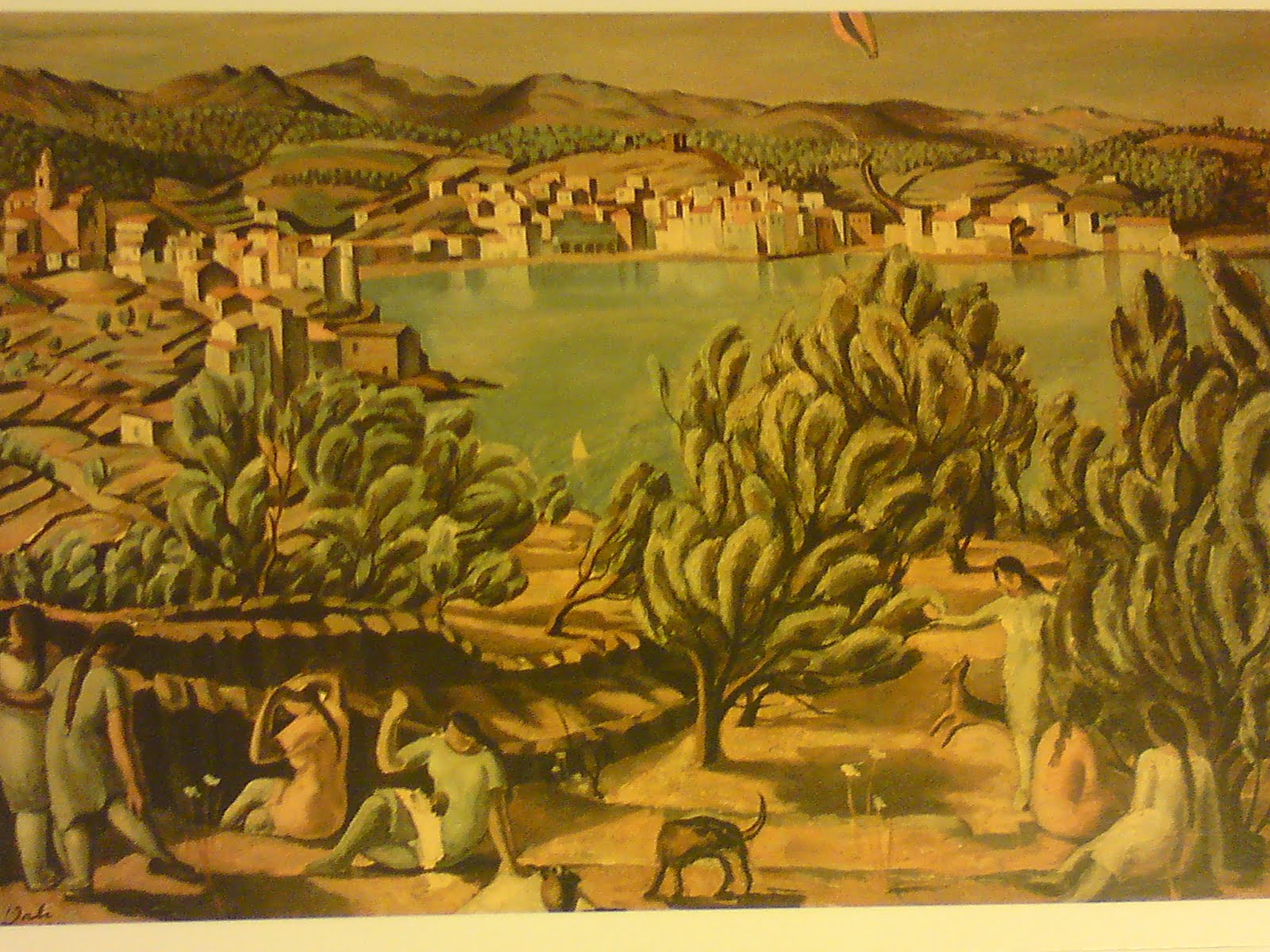 Ages, and many wild paintings, later I saw this amazing item from 1939.
 And then, by some miracle, they'd made both images into postcards. Serendipity.
Putting aside momentarily what these images says about one human's creative development within a 16-year span, I would like to draw your attention to the echoes of the first painting that exist in the second. The rocky outcrops extending from the paintings' left-hand sides. The languid ladies. The arms raised in carefree greeting. The woman touching her leg and the melting piano. The dog and the tuba.
We could try to assign these parallels to a lack of imagination on Dali's part, but I don't think that particular mud would stick in this case.
From the first time I saw these two images, so many implausible visions apart in the art gallery, I wondered if Dali had seen those parallels. Surely he did. I'm no artist. Maybe it has something to do with balance or something.
But I prefer to imagine that the correspondence between these two images reflects something of Dali's subconscious and, therefore, something of humanity.
Perhaps we all go through life according to a vision or pattern that exists innately within us, and which we cannot avoid. Perhaps life is simply about fitting the inexplicable into a form that we can grasp. Perhaps the world can only be interpreted in light of certain visions, certain necessities, so that whenever we perceive a rocky outcrop, we start looking for some kind of fluid female form and dog that doubles as a tuba.
Can we overcome our initial repertoire of forms and patterns? Or are they simply reinterpreted into different visions along essentially the same lines as we fit more and more experiences into those same frames? The Dali exhibition failed to answer either question.
On the other hand, it could be that these paintings are completely different and I'm seeing parallels that do not exist. Which says a whole lot less about Dali, but probably explains why I enjoy going to exhibitions so much.
Subscribe to:
Posts (Atom)